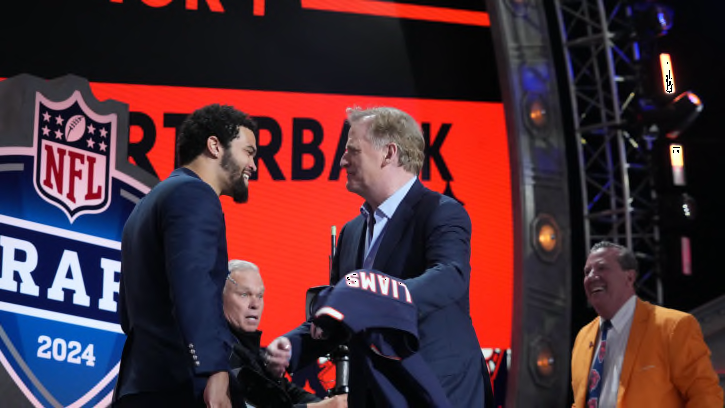
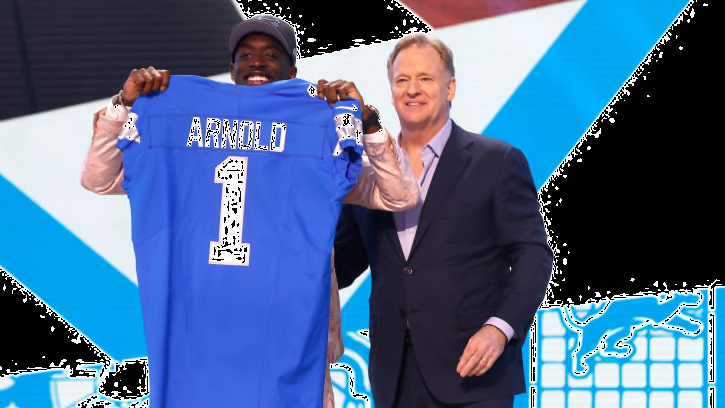
Quarterbacks in particular seem to bring with them particular interest as they will ultimately be the face of the franchise, and a miss at the prime position can cost a team for years to come. This year is no different as the Lions face the decision of drafting either Matthew Stafford of Georgia or Mark Sanchez of USC with the first pick, or going with another player of need. However, their success or failure in the NFL will mainly be tied to their sack % as professionals, and other than a few exceptions, nothing more.
Everyone will ask some of the following questions, if not all of them, and others, to determine whether or not they will be successful as NFL QB's: Did he win the Heisman? Did he win a national title? Did he play in a pro-style offense? How many games did he start? What was his completion %? 40-yard time? How did he do at the combine? The questions will keep on coming until he has proven himself year after year in the NFL, just ask Eli Manning. Conversely, nobody asks what was our sack % last year? Can we protect this guy? Can he succeed in our system and with the tools we are giving him?
Mark Schlereth on ESPN's NFL Live has continually said past performance is the best indicator of future potential/performance. It would be hard to disagree with that statement; however, it is misdirected - to a degree. Why would a team that gave up over 50 sacks the year before (approximately 10% of their pass plays) realistically believe that Stafford or Sanchez would thrive under their system, and be the savior of their franchise? Sure Stafford and Sanchez have great arms, and likely are worthy of being top-10 picks, but the reality is, building a winner does not happen overnight, nor does one player make a difference on an NFL team, as he is only one cog in a very complex wheel.
Joe Montana did not win the Super Bowl in Kansas City and Brett Favre fell flat on his face in New York last year, so how on earth can a team expect a rookie QB to do the same for them? It is complete folly to think so, and the stats back it up. By looking back as far as the early-mid 80's, when sacks began to be recorded, and by comparing arguably the best QB's against what most would classify as busts, and even those that wouldn't be classified as busts but not great one, we clearly see one common trait - sack % equals wins and losses, impacts completion %, QB rating, touchdown to interception ratio and yards per attempt.
In 2008 the Detroit Lions went 0-16 and gave up 52 sacks, or approximately on sack every 10 pass attempts, and keep in mind this does not include hits on the quarterback. This year they are drafting first and are thinking about selecting Stafford or Sanchez according to McShay and Kiper. How sorely mistaken they would be to do so, and here is why:
The average NFL QB is sacked on about 5% of their pass attempts historically speaking, give or take a few tenths of a point, and if the numbers get above that season's average, most QB's flounder. Dan Marino led the NFL in least sacks taken AS A PERCENTAGE OF ASS PLAYS in 10 seasons, and was in the top-10 for the lowest sack % every season of his career, and his statistics speak for themselves. The argument though is not about whether he won a Super Bowl, but if he was a successful QB, and the resounding answer is yes, and his career sack % was 3.13% according to Pro Football Reference.
Brett Favre managed a sack % of 4.8% for his career, but in New York his sack % hit 5.4%, and again he was routinely in the top-10 QB's for fewest sacks absorbed during his career. Troy Aikman for his part never fell below 10th in sacks taken as a percentage of pass plays, though it was not until 1992 that the Cowboys had a winning record - again the statistic in question - sack % (4.6%) compared to 6.1%, 8.9% and 8.1% in his first three seasons.
The Manning brothers for their part follow the same rule. Peyton has only had 2 losing seasons in his career - his rookie year (3-13) and a 6-10 campaign in 2001. He has never been sacked on more than 4% of his drop backs in his career outside of 2001, and he is on of the best in the game, yet as a veteran in 2001 he could not manage a winning record and had the lowest QB rating of his career outside of his rookie year. Eli, on the other hand, has been sacked at a higher pace than Peyton and his stats reflect that.
Drew Bledsoe, who finished his career with a 98-95 career mark averaged a sack % of 6.5% throughout his career, and never managed a 10-win season or greater after 1998 when his sack % never fell below 7%, and his QB rating dropped significantly as well. His successor in New England, Tom Brady, has never been above 6% and never been worse than 10th in this category. In 2007, when he threw 50 TD passes, he was sacked on only 3.5% of New England's pass plays, but in the Super Bowl against the Giants that figure ballooned to more than 10% - result - the Patriots lost.
Matt Cassel, arguably a rookie last year, was sacked on approximately 8.3% of his drop backs, yet managed a pretty good season statistically. In four of five losses, he was sacked 12% of the time, with the Pats defense only picking up a total of 4 during that span, 3 of which came in the shootout against the Jets. This anomaly in stats could be attributed to coaching, talent or the players around him. Either way, we only have one season to judge him on, so the jury is still out on Cassel.
Taking another approach, David Carr for his part has averaged a 10.6% sack % over his career, and we know what has happened to him since being selected in the first round. Tim Couch in Cleveland averaged 8.8%, with hi best year ratings-wise coming the year he was sacked 4.4% of the time, but only played 7 games that season. J.P. Losman 9.9%, Kyle Boller above 7%, Tony Banks 8.8% and Alex Smith 9.2%.
Kerry Collins, not a great one by any means, and truly better as a backup was only sacked on 1.9% of his passes attempts last year, and the Titans went 13-3, best in the NFL. Vinny Testaverde never saw his rating go above 80 points in a season where he started at least 10 games until his sack % fell below 6%, with his two best years from a team wins standpoint being 1998 when he went 12-1 and 2001 when he went 10-6, and during his time in Tampa Bay, his sack % average 8.38%.
There are anomalies to this theory, and QB's have shown the ability to be able to win in spite of this, for example Ben Roethlisberger and Joe Flacco last year. However, both of these players had very stout defenses to help keep the in the game, something most teams picking early don't have the luxury of doing. That said, the lack of protection also ultimately has cost both teams the ability to win crucial games, with the Steelers only beating the Seahawks due to a negligible call at the goal line that involved Roethlisberger and could have gone either way.
For his part, Matt Ryan was only sacked 3.8% of the time passing last year, and we know what he did as a rookie, leading Atlanta to an 11-5 record. It comes as no surprise that he was able to have a rating of 87.7, and this can be attributed to an excellent ground game and a good offensive line. Bottom line is that a QB's propensity to get sacked will affect the overall success or failure of a team, and ultimately of that QB as far as their careers go.
The stats are in favor of this argument, and they support the notion that team must develop the talent around the QB first before they make the investment in a quarterback and want to give him the best chance to succeed. Having given up sacks on 10% of their pass plays in 2008, the Lions should be looking to draft on the offensive line or defensively in this draft, and go for a QB in next year's draft, allowing them time to have the existing players on the team to lean the system and be able to help the new signal caller learn the system.
Note: All statistical references taken from pro-football-reference.com, nfl.com and usatoday.com.

DeLeah Caro
Anne V


Comments (6) Add A Comment
Nice effort. I agree with the sentiment and I agree that the Lions would be wise to invest in a LT before they invest in a QB.
However, I do have a nit to pick. You need to explore cause and effect relationships with this stat. You have a correlation, which does not prove cause and effect. For example, good teams that are winning are usually running the ball to kill the clock at the end of the game, whereas poor teams are recklessly passing trying to catch up before the clock runs out. Does that mean the losing team has worse protection than the winning team? It may just mean that the losing team was in a position to be sacked at a higher rate.
The Ram
Pittsburgh, PA
Total Comments (28589)
It goes both ways, and I agree there are exceptions to every rule, and there will flaws in an obviously broad argument, but the reality is that at the end of the day sacks will affect the players' ability to develop, and if you look at the majority of busts in the NFL at the QB position, and look at the sack % and you see a pretty irrefutable argument in favor of my post.
Taking your position, though, what about teams like the Eagles though who routinely pass all the time, but never have a great offense, and never were able to win the big one? McNabb, as I am sure you would agree is a great talent, and if he had better talent around him would likely have won one or two Super Bowls... But have a look at his sack stats, and his recent injury history.
TheMason
Charlotte , NC
Total Comments (48)
But it also depends on when you throw. The Eagles base offense is predicated on throwing the ball. But there is still uncertainty as to when they will run, so defenses cannot be bull rushing the QB on every down. When a team is down by 14 with six minutes left, both sides know that the only hope for the team losing is to throw on ever down, and more sacks occur.
Other factors that come into play are a QB's decision making. It's not solely the quality of the line that dictates sacks. A QB who can't get rid of the ball on time invites his own calamity.
Look at the Patriots. In 2007 with a healthy Tom Brady they allowed 21 sacks, 5th best in the league. Then Brady gets hurt and Matt Cassel takes over in the same offense with the exact same linemen and is sacked 48 times, 5th WORST in the nfl. I have a hard time believing that the line suddenly got worse.
I'm not trying to discredit your conclusion, clearly getting sacked less is a good thing, but I'm just trying to challenge you to see if you have weighed all of the factors. It's just one of those topics where it is hard to draw conclusions in a vacuum.
Do teams that run the ball more win? Or does winning afford more opportunities for running the ball? It's hard to be certain either way. It is the same with sacks.
The Ram
Pittsburgh, PA
Total Comments (28589)
Agreed, and as I sadi there are exceptions to the rule, but if the O-line can't block, and therefore a team can't run, how are they expected to protect the QB? The argument can be made on a myriad of levels. I was merely poitning out the fact that sack % seems to overwhelmingly affect a QB"s and team's overall success or failure - other than factors such as talent, work-ethic, stellar defenses, etc, which are the exceptions to the rule.
TheMason
Charlotte , NC
Total Comments (48)
Also, 48 sacks may have been 5th worst in the league, but take out the losses and his sack % was around 7%, and I think Cassel was an exception to the rule.
TheMason
Charlotte , NC
Total Comments (48)
"Dan Marino led the NFL in least sacks taken AS A PERCENTAGE OF ASS PLAYS in 10 seasons"
am I the only one who caught that?
probably
Go Packers!!!!
superpoo
East Point, GA
Total Comments (3)
Comment
Remember to keep your posts clean. Profanity will get filtered, and offensive comments will be removed.